Cross-agency work
One event or request can involve public safety, transportation, utilities, health, public works, and external partners.
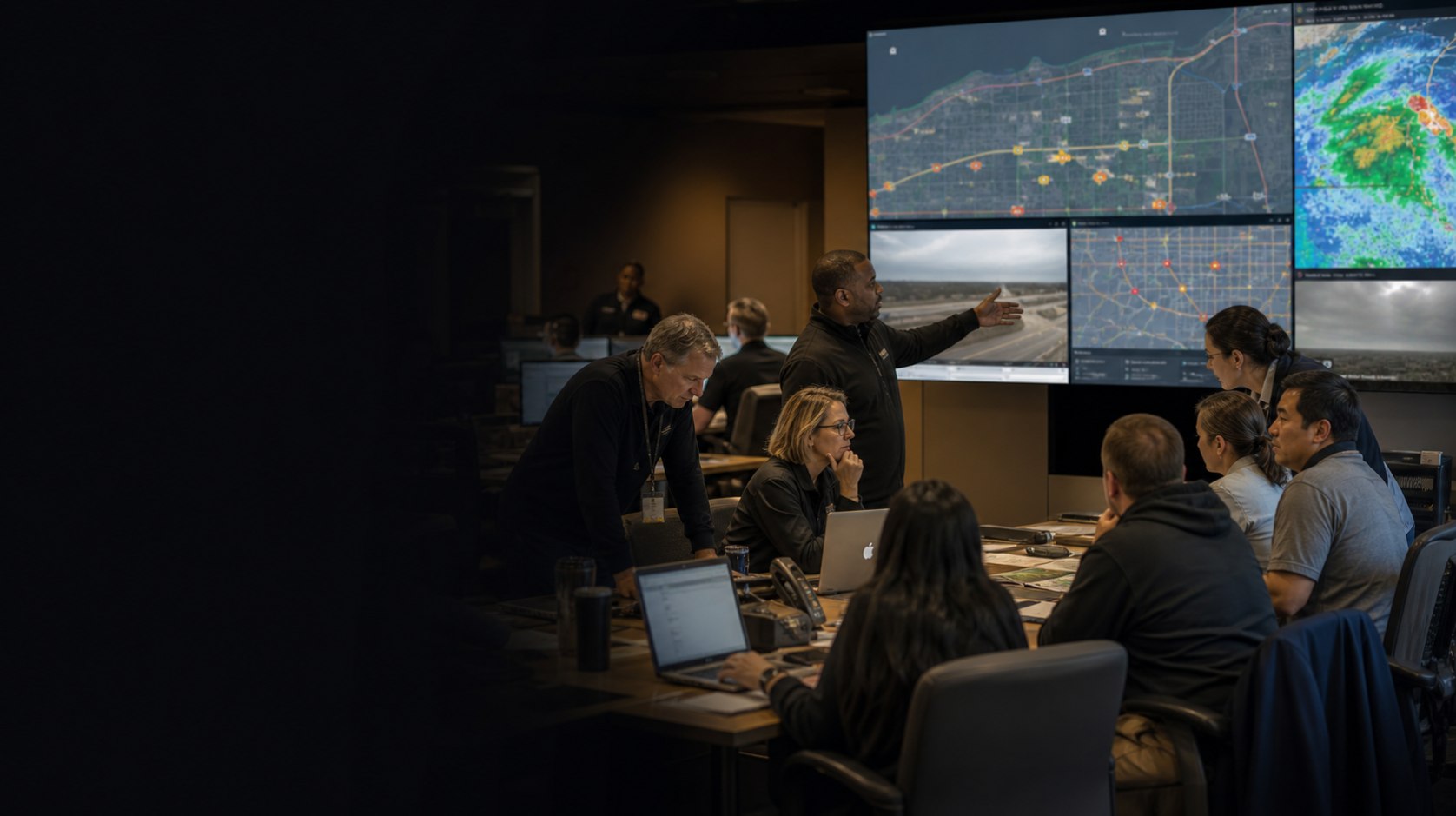
Industries / State, Local & Public Safety
Corteq connects emergency operations, public works, transit, constituent services, permitting, and field response into governed workflows built for public accountability.
Civic operations / Community resilience
Operating reality
A public outcome crosses jurisdictions, departments, contractors, records, communications, policy, field crews, and community organizations. Cortex connects that operating thread without erasing local authority.
One event or request can involve public safety, transportation, utilities, health, public works, and external partners.
Modern platforms coexist with spreadsheets, radio, paper, legacy case systems, and disconnected field operations.
Actions must remain equitable, explainable, accessible, attributable, and open to review.
What Corteq builds
Cortex connects the systems and authorities already in place so agencies coordinate around one incident, case, or public outcome.
Connect hazards, infrastructure, roads, shelters, resources, requests, forecasts, and field reports.
Assemble the record, apply policy, route work, coordinate updates, and preserve the final disposition.
Connect condition, demand, work, routes, dependencies, communications, and restoration priorities.
Surface anomalous patterns and competing explanations without automating consequential judgment.
Operating thread
The sequence stays visible from input through action. Each step preserves the context, authority, and evidence the next step depends on.
Capture incidents, requests, sensor signals, calls, records, forecasts, and field reports.
Resolve jurisdiction, service dependency, priority, available resource, policy, and community effect.
Place options, evidence, equity considerations, and required approvals with the public owner.
Execute and communicate the action, update shared state, and preserve the public record.
Mission outcomes
The standard is not whether the model runs. It is whether the workflow moves faster, remains governed, and produces an outcome the organization can inspect.
Everyone acts from the same incident or service context while retaining their authority.
Automation moves information and work between queues instead of creating another queue.
Evidence, policy, recommendation, decision, communication, and result stay connected.
Built on Corteq Cortex
Every deployment uses the same five deep-dive layers while the mission objects, workflows, policies, systems, and evidence change by industry.
Start with the operating thread
We will map the systems, context, human gates, deployment boundary, evaluation plan, and fastest path to a fieldable capability.
Request a mission briefingCMMI Level 3 · CAGE 03Z83 · SAM UEI RCD3J3SLJEZ3
Privacy Policy