Adapters are governed products
Connections are versioned, tested, monitored, and owned rather than accumulated as point-to-point integration debt.
Cortex architecture / Layer 04
The interoperability layer between mission systems: governed adapters, semantic mappings, resilient event exchange, and synchronization designed to keep working through latency, isolation, and link loss.

Operational thread
The layer is not a feature sitting beside the workflow. It transforms what enters the mission thread and preserves what leaves it.
Field evidence / Layer 04
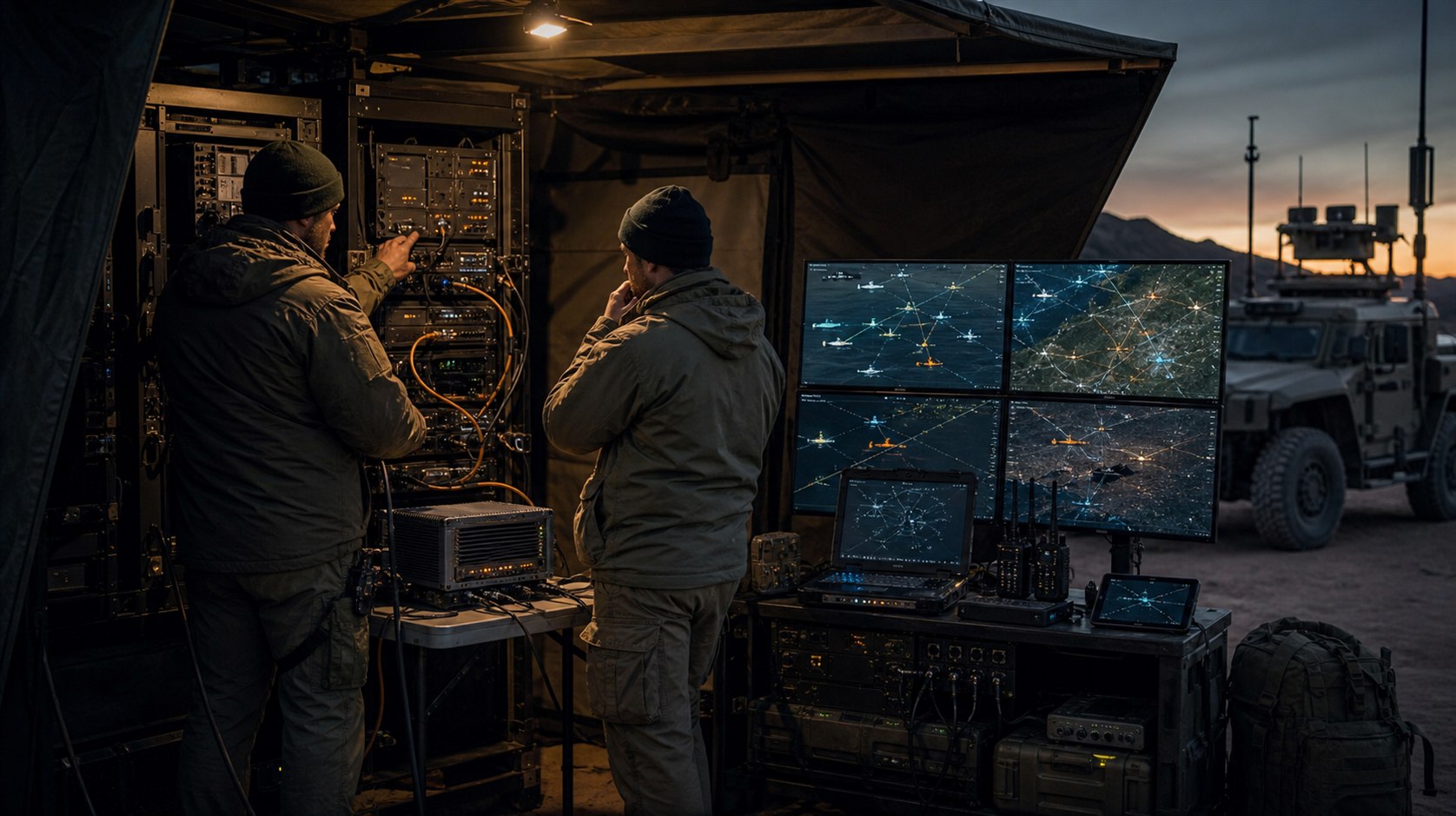
Governed adapters and disruption-tolerant exchange carry mission meaning across old and new systems without requiring a clean-sheet environment.
How it works
Each mechanism is inspectable on its own. Together they make the layer operational, governed, and reviewable inside the larger Cortex mission thread.
Connections are versioned, tested, monitored, and owned rather than accumulated as point-to-point integration debt.
Semantic mappings preserve mission identity, units, authority, provenance, and time as data crosses system boundaries.
Store-and-forward delivery, idempotent events, and reconciliation keep the mission thread coherent through latency and link loss.
The system records what moved, under which policy, between which endpoints, and whether the receiving system accepted it.
What it produces
The layer leaves behind concrete, queryable artifacts. Review does not depend on reconstructing what the system did from memory after the fact.
The complete stack
No layer stands alone. Context, bounded execution, resilient interoperability, continuous evidence, and the deployment boundary move together from mission intent to accountable outcome.
Start with the mission
We will map how it runs, where human authority belongs, what evidence it produces, and what it takes to field inside your boundary.
Request a mission briefingCMMI Level 3 · CAGE 03Z83 · SAM UEI RCD3J3SLJEZ3
Privacy Policy