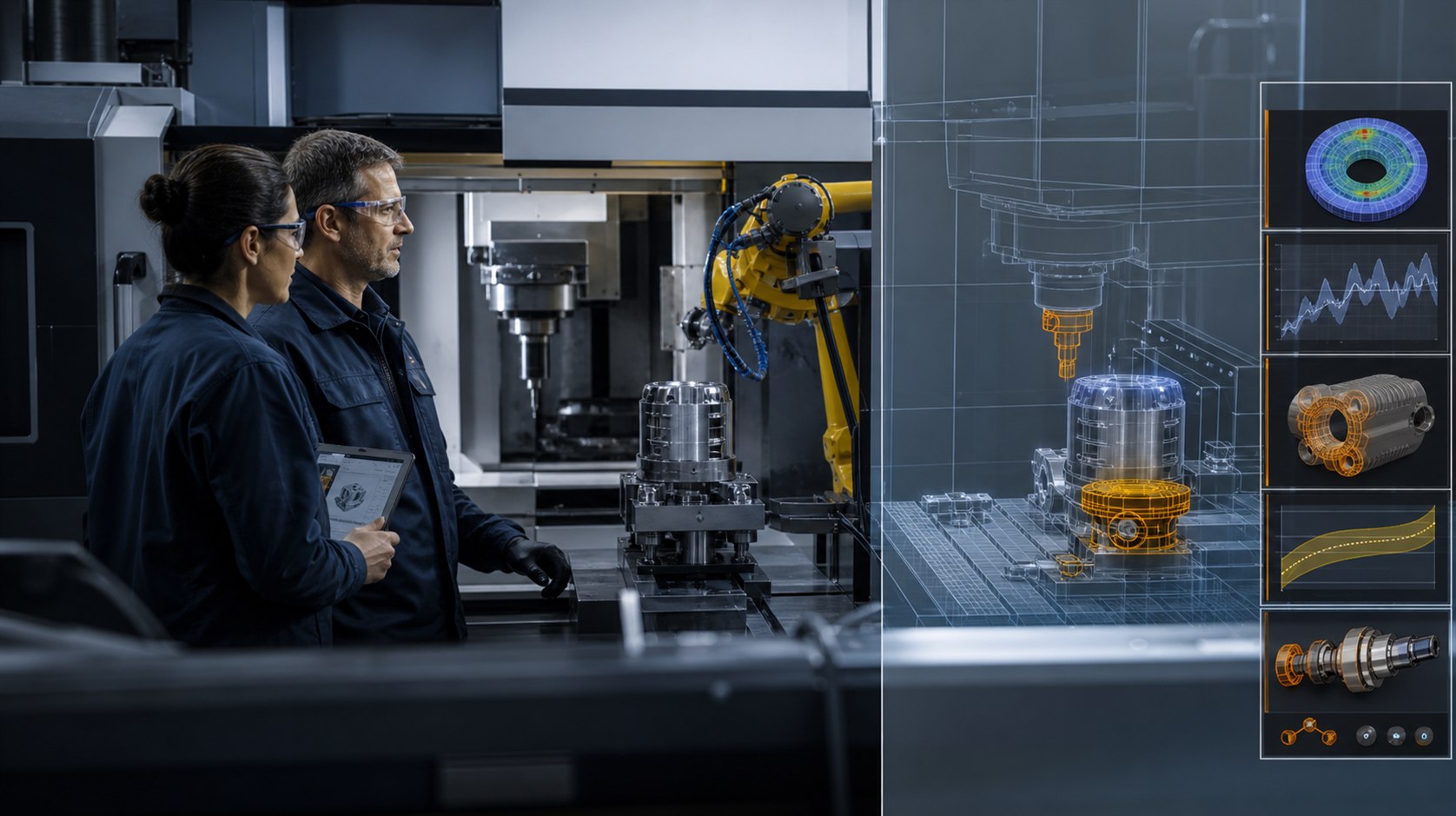
Manufacturers are combining smart sensors, industrial data, simulation, computer vision, and AI to represent and optimize production. Yet a digital twin can become an expensive dashboard if its scope is vague, its data cannot interoperate, or no one knows when to trust its predictions.
Define the decision before the twin
A twin built for virtual commissioning differs from one built for predictive maintenance, quality control, scheduling, or cyber detection. Each needs specific assets, signals, update rates, physics, uncertainty, and acceptance criteria. NIST’s work emphasizes requirements, interoperability, and verification, validation, and uncertainty quantification because credibility is use-case dependent.
The right question is not whether the factory has a twin. It is whether a named team can use a validated representation to improve a defined production decision.
Connect the digital thread
Product definition, process plan, machine state, inspection result, nonconformance, maintenance history, and production order often live in separate systems. Stable identifiers and semantic mappings allow a prediction to travel with its context. When a quality model flags a part, the system should connect the signal to machine settings, material lot, operator action, specification, and downstream risk.
Keep action within industrial authority
AI may recommend a parameter change, inspection, maintenance window, or schedule adjustment. Deterministic safety controls remain independent. Tool permissions reflect cell, line, role, and operating mode. High-impact changes require approval, and every action records the model and plant state that justified it.
A trustworthy twin is not the most detailed representation. It is the smallest validated model that improves a real decision without weakening control.
Scale through reusable interfaces
Start with one costly failure mode and one line. Measure prediction lead time, false interventions, downtime, scrap, rework, throughput, and operator burden. Standardize the object model and interfaces that prove useful, then extend them to the next asset or plant. This creates a composable industrial capability rather than a collection of bespoke twins.
Commission the human-machine team too. Operators need to understand which signals influence a recommendation, how to reject it, and when the twin is outside its validated envelope. Override data should return to engineering as structured evidence; repeated overrides often reveal a missing operating condition rather than resistant users.
Where Corteq fits
Corteq connects machine, process, quality, maintenance, production, supply, and operator context into a governed digital thread. Agents translate validated twin outputs into bounded recommendations and approved work across MES, QMS, EAM, and planning systems.
Corteq approaches this as an operating-system problem, not a point-tool purchase. Corteq Cortex™ joins mission context, bounded agents, existing systems, continuous controls, and zero-trust enforcement so teams can move from experiment to governed production. Explore our Advanced Manufacturing capabilities or start a working session.
Selected primary sources