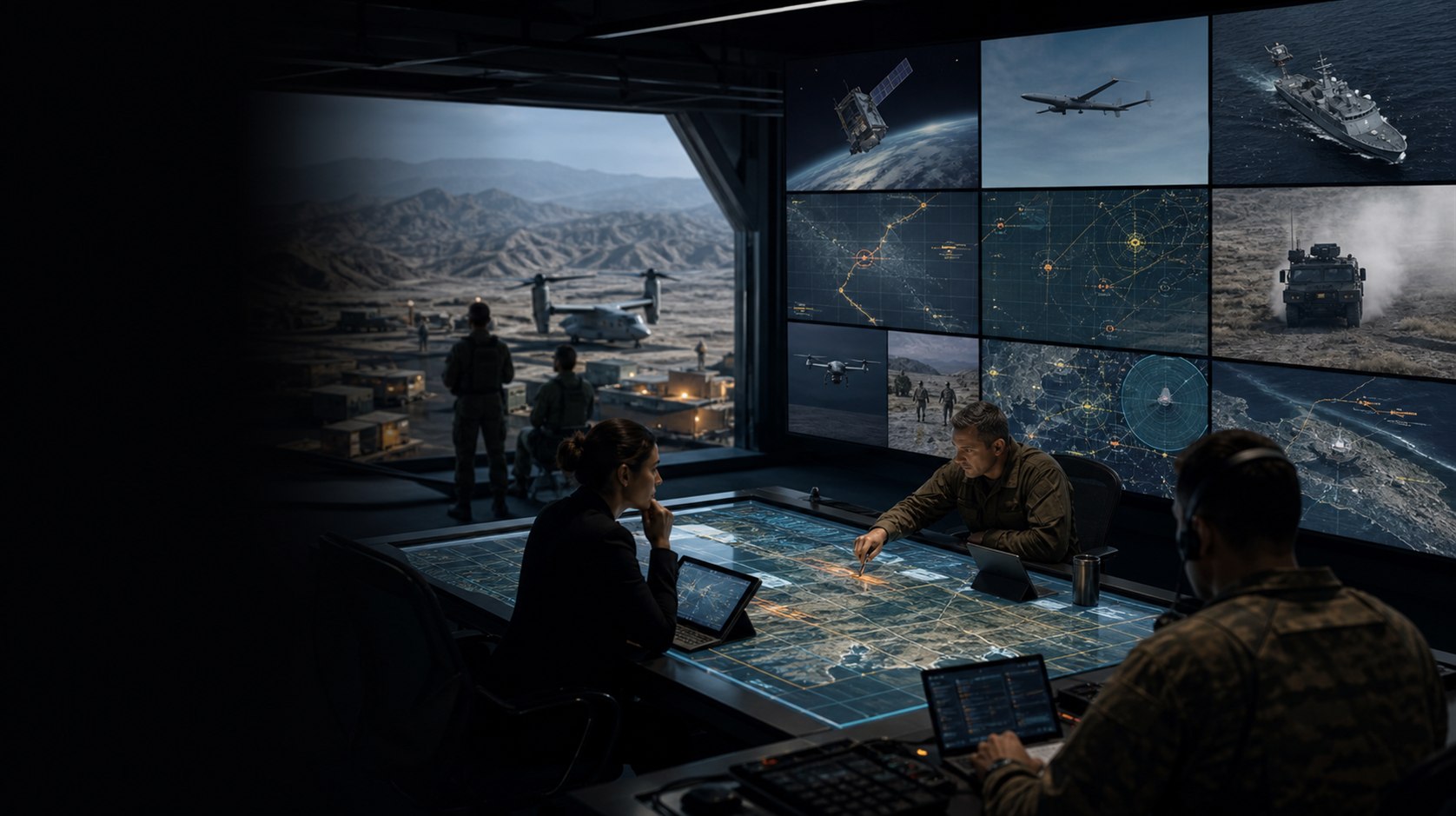
Defense organizations are accelerating generative AI, decision support, autonomy, logistics, intelligence, and cyber use cases. Yet many decisive environments have intermittent bandwidth, heterogeneous sensors, coalition boundaries, and rapidly changing authority. Sending every observation to a central model is neither fast enough nor resilient enough.
The edge needs context, not just inference
A compact model can classify imagery or summarize traffic locally. That does not make it mission-aware. The system also needs to know which sensor produced an observation, how fresh it is, what platform and unit it concerns, which sources corroborate it, and what actions are authorized in the current phase.
A mission graph carries those relationships in a form software and people can inspect. It turns isolated model outputs into evidence tied to objects, time, place, provenance, and command intent.
Compose capabilities behind open interfaces
Open, government-owned interfaces reduce dependency on any single model, data platform, or application. The architecture should allow a task to select among local models, reach-back services, deterministic rules, and human expertise based on latency, classification, confidence, and availability.
This is also how new capability reaches the field faster. A model can be upgraded without changing the mission object model. A sensor can join without rewriting every application. A coalition partner can receive an authorized view without exposing the full data estate.
Synchronize decisions, not everything
Disconnected operations demand selective movement. Prioritize changes to mission state, threat, policy, tasking, and model validity. Preserve provenance and conflict history so reconnecting nodes do not silently overwrite one another. The edge should continue safely with the last known policy and make uncertainty visible.
Decision advantage comes from getting the right context and authority to the point of action—not from moving the most data.
Evaluate under mission conditions
Laboratory accuracy is insufficient. Test bandwidth loss, stale tracks, spoofed inputs, degraded compute, model disagreement, and operator overload. Measure time to a defensible decision, rejected recommendations, data moved, energy consumed, and recovery after reconnection. The most advanced edge AI is the one the mission can still command when conditions deteriorate.
Where Corteq fits
Corteq’s Mission Graph creates a portable representation of mission objects, relationships, provenance, and authority. Agent Studio packages task-specific behavior for the edge, while Integration Fabric synchronizes only the data and model updates the mission can trust and afford to move.
Corteq approaches this as an operating-system problem, not a point-tool purchase. Corteq Cortex™ joins mission context, bounded agents, existing systems, continuous controls, and zero-trust enforcement so teams can move from experiment to governed production. Explore our Intelligence & Defense capabilities or start a working session.
Selected primary sources